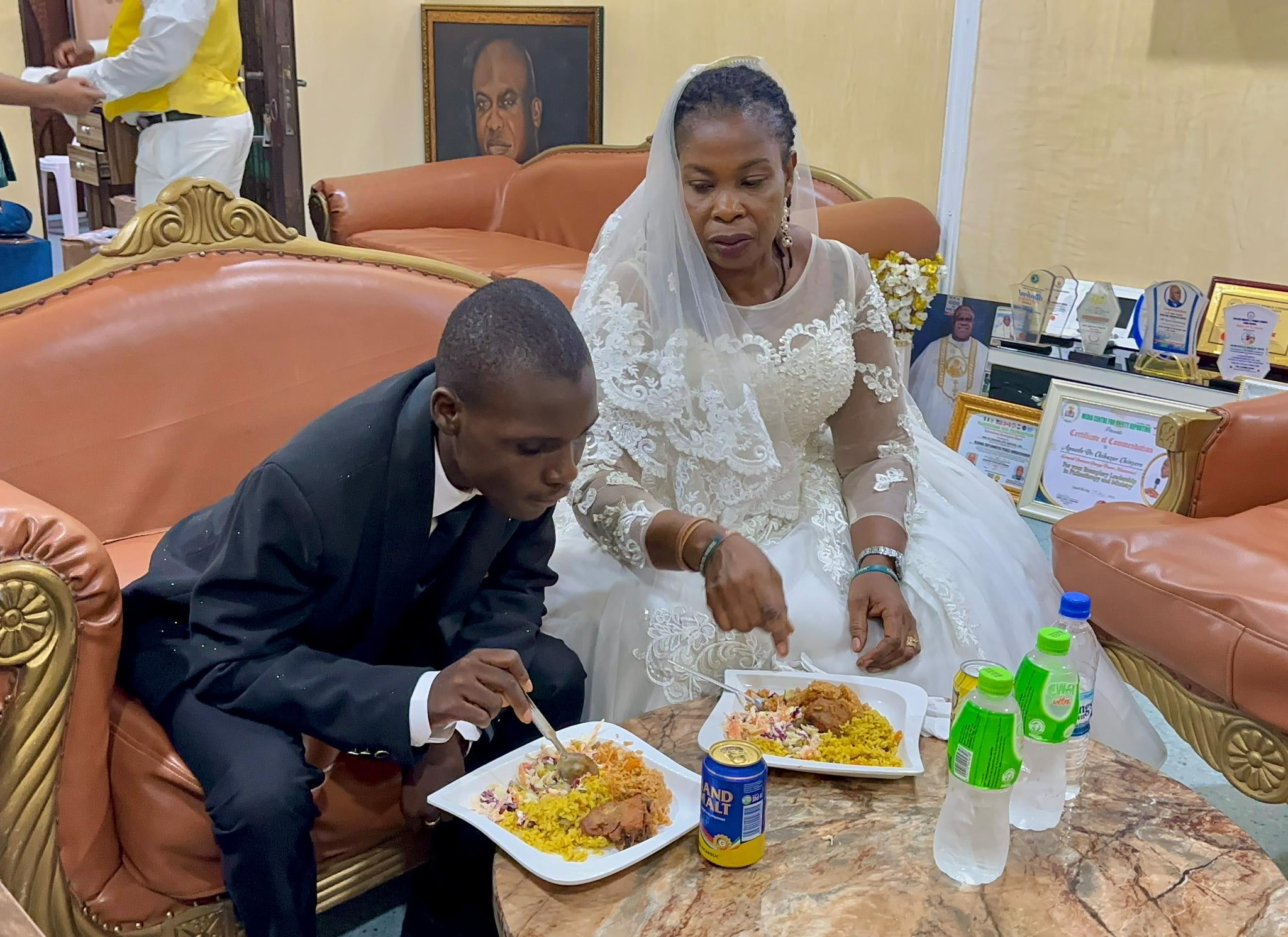
Women’s History Month just ended. Today is World Autism Awareness Day. Nigeria gave us this story right in the middle.
Last month was Women’s History Month. Today, April 2nd, is World Autism Awareness Day. Two global moments that ask us to reckon with people who have historically been spoken for, managed, dismissed, and decided about.
People whose autonomy gets treated as optional, whose dignity gets dressed up as charity, and whose futures get planned by whoever is closest to power in the room.
Nigeria gave us the perfect case study of Aboy, and now we wonder if we’ve even made any progress.

How It Happened
On Friday, March 28, 2026, Apostle Chibuzor Gift Chinyere, founder of Omega Power Ministries (OPM) in Port Harcourt, published a post on his Facebook page. He was looking for a wife. Not for himself. For Aboy, his adopted son, a young man with autism who is non-verbal, cannot feed or bathe himself, does not understand verbal instruction, and has been under OPM’s care since he was abandoned as an infant at the pastor’s gate.
The post read like a job listing:
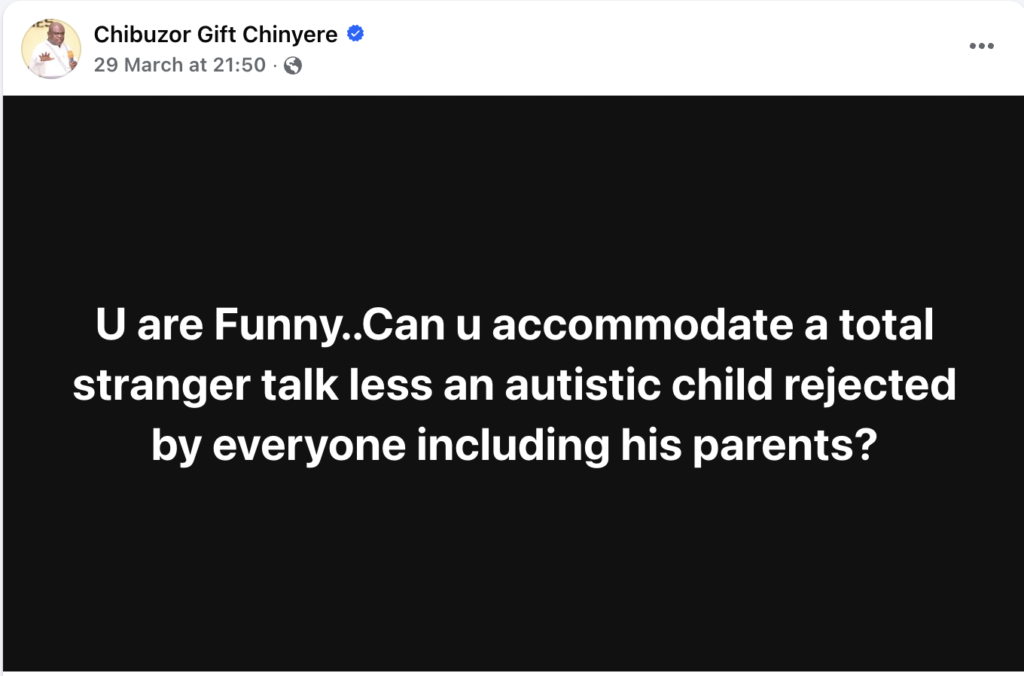
“Marry him and get benefits. Since the unknown parents dump him at my gate, he has been growing to become a man. Any lady that accepts to marry him. All marital rites would be paid. Free accommodation for life. Monthly salary for life. A house shall be built for the 2 couples of them. Free medical for both couples for life. Vacation overseas for both couples. She can be a single mother, a grandmother, etc. But she must not be autistic. And many other huge financial benefits. Any interested girl or woman, go to OPM headquarters and ask for the HEAD of OPM welfare.”
The disqualifiers are at the end. She can be anything, a single mother, a grandmother, whatever, but she must not be autistic. Beyond that, the post has no interest in who she is. Her preferences, her history, her personhood do not feature. What matters is whether she will take the job.
Because that is what this is: a job posting.
The backlash was immediate, sharp, and largely focused on what the post said about women. Women on social media were right to be outraged. The framing was transparent: here is a problem, here are the benefits, apply within.
Then He Explained Himself
Here is where things got worse.
After the backlash, Apostle Chinyere posted a more detailed explanation of why he had put the ad up. He described Aboy’s sexual urges as an “uncontrollable ogre,” and explained that because Aboy could not understand what was happening to his own body or be spoken to about it, he had narrowed the situation down to three options.
Option one: have a driver drop Aboy at a junction somewhere.
Option two: arrange for fornication, which he could not sanction as sin.
Option three, which he chose: “Make it legal by paying the price of a grandmother or any advanced lady. That would be feeding, clothing him, and taking care of his sexual needs. Send them overseas for vacation. Build a house in their names. Place her on a lifetime salary. But she must not kill the boy. If she kills the boy, she loses everything.”
Can we pause to sit with the hollow, dark absurdity of that sentence? “She must not kill the boy; if she kills the boy, she loses everything?”
Read that again. A woman’s purpose in this arrangement is to feed, clothe, and sexually service a man who cannot communicate. Her compensation is a house and a salary. Her obligation is his survival, at minimum, confirmed by whether he is alive in ten years to trigger the N20 million clause.
A man’s survival was written into the contract as a contingency. That detail was in the original post. Most coverage reported it without pause.
He apologised on Saturday, specifically to women, saying he had no intention of degrading anyone. And, he went forward to post images of “autistic people getting married to normal” people as if that was ever the point of the conversation. He insisted that he offering money for the marriage was because no one else would do that for free.
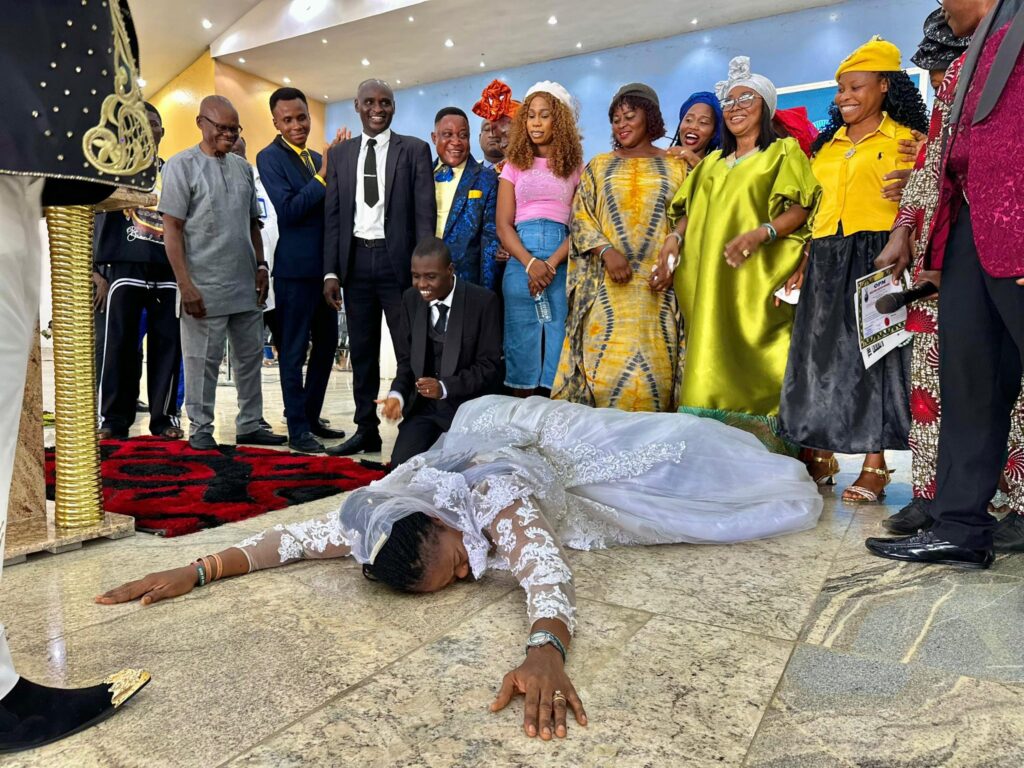
On Sunday, March 29, the wedding took place anyway.
The Woman Who Stepped Forward
An Edo-born woman, a widow and mother of three, came forward. She said the decision was spiritual, guided by a divine instruction she received and immediately texted the pastor about.
She was clear that she understood what she was walking into.
She said: “I want to pay that sacrifice. It is a very big sacrifice. When I look at our Lord Jesus Christ, the sacrifice he paid on the cross of Calvary. Nothing is too big for me to do the same. Not only will I marry him, but I will also take care of him as a son. As my king. As a husband. As a brother.”
She used the word sacrifice. She meant it literally. She compared her marriage to the crucifixion of Christ. And they obviously ignored the financial implications that came with that sacrifice.
The frustrating thing is that nobody can take away the sincerity of her belief. She made a decision with full awareness and stood by it publicly under significant pressure. There is something in that that deserves to be respected. But the same thing that makes her decision understandable is the thing that should make us deeply uncomfortable: a society that has consistently taught women that their most valuable contribution is endurance, self-erasure, and suffering reframed as virtue has produced exactly the woman this arrangement needed.
She was not coerced into this in any legal or criminal sense. But she was absolutely shaped by church culture, by a society that conflates female suffering with female holiness, into someone for whom this felt like a calling rather than an exploitation. That is the more insidious version of the same problem. And of course, do we forget that the country’s economic situation was not helpful to her?
The pastor did not have to put a gun to anyone’s head. He just had to put the post up and wait for a woman who needed the money, who had been sold the religious notion that sacrifice is the highest form of love.
What Everyone Was Angry About, and What They Should Also Be Angry About
Social media’s anger was overwhelmingly directed at the woman’s angle, and rightly so. The ad was degrading in its framing, transactional in its structure, and revealed exactly how much some people think a woman’s life is worth: a house, a salary, a vacation, and the honor of service.
But the conversation had a significant blind spot.
Aboy.
The man at the center of this entire story, the man whose name was on the contract, the man who was dressed by someone else and stood at an altar arranged by someone else, was largely treated as a backdrop. A reason for the debate, not a subject of it. The outrage was on behalf of women, which was correct, but it quietly accepted the assumption that the arrangement was acceptable on his part. That he was fine. That this was for him.
The question that barely got asked: Did Aboy want to get married?
And no, the question is not about an autistic person’s right to marriage but rather about stripping them of the right to make that decision. Autistic people across the spectrum have full, rich emotional lives and the legal and moral right to form relationships and marry if they choose to and if they are able to give informed consent. That is not in dispute.
The specific question about this specific man: how does a person who cannot speak, cannot understand verbal instruction, and does not know what is happening to his own body, according to the person who has raised him, consent to a marriage?
The answer, based on everything that has been publicly shared, is that he did not. Nobody asked him. Nobody could ask him, at least not through conventional means. And rather than treating that as a serious ethical and legal problem that required the involvement of qualified disability professionals, a judge, an advocate, or any formal assessment process, it was treated as irrelevant. The pastor decided. The woman agreed. The wedding happened. Nigeria moved on to debating whether it was insulting to women.
Both things are true at the same time.
The arrangement was insulting to women, and it was a violation of Aboy’s autonomy. These are not competing arguments. They are the same argument about the same underlying principle: that marginalised people, people society has decided are a burden or a problem to be managed, do not get the full courtesy of being asked what they want.
The Social Math of Who Gets to Decide
What the OPM incident reveals, when you strip away the specific details and look at its skeleton, is a very consistent social pattern.
A disabled man cannot speak for himself. A pastor, with “good intentions” and no professional support, decides on his behalf. A woman who claims “genuine faith,” ignoring the payment aspect, agrees to execute the contract with the excuse that she is being “self-sacrificial.”
The state, which passed a law in 2018 guaranteeing the rights of disabled persons but has never funded the infrastructure to make those rights real, is nowhere in the room. The church fills the gap the government left, without training, without oversight, without accountability. And two marginalised people, one disabled, one a woman, end up in an arrangement that primarily serves the administrative convenience of the person with the most power.
This is a direct violation of the Discrimination Against Persons with Disabilities (Prohibition) Act of 2018, which was designed to protect people exactly like Aboy from “cruel, inhuman, or degrading treatment.” For God’s sake, the pastor referred to him as an uncontrollable ogre, or did we all miss what that meant?
The law mandates the right to liberty and, crucially, the right to give or withhold informed consent. By allowing a religious institution to bypass these legal guardrails, the Nigerian government has signaled that for people with disabilities, “rights” are a luxury, and “management” is the only reality.
This is not unique to Nigeria. It is not unique to this pastor. It is the shape of what happens when society decides that certain people’s lives are management problems rather than human experiences.
Women know this shape intimately. It is the shape of being spoken for in decisions about your own reproductive health, your own marriage, your own body. It is the shape of being told that your suffering is spiritual, your sacrifice is admirable, and your endurance is your greatest gift. It is the shape of a system that extracts labour from women, including emotional, domestic, and intimate labour, and calls it devotion.
Disabled people, particularly those who are non-verbal or who require significant support, know this shape too. It is the shape of being managed rather than supported, of having your needs addressed in ways that are convenient for the caregiver, of living inside decisions that were made about you, for you, without you.
The gap between what Nigeria’s disability law promises and what disabled people actually receive is one of the most urgent unresolved tensions in the country’s social welfare landscape, and it is most dangerous for autistic adults who age out of whatever limited support system they once had.
Both groups were failed here. One of them, the woman, could at least consent to being failed. The other one could not.
The Apology That Changed Nothing
Apostle Chinyere “apologised” to women. He said he had no intention of degrading anyone, that the arrangement was motivated by love for Aboy, that he was trying to find a sustainable solution. He did not retract the plan. He did not postpone the wedding. He apologised on Saturday, and the ceremony went ahead on Sunday.
The apology was directed at women because their outrage was the loudest and most public. The ethical problem, which includes the question of what it means to arrange a marriage for a man who cannot understand he is getting married, was not part of the apology nor the public conversations that followed.
Or wait, why should we be offended after all, he’s helping the uncontrollable ogre that is Ahoy?
Last month, Nigerian social media was full of Women’s History Month content celebrating women’s resilience and strength. Women’s ability to carry weight that was never theirs to carry. And then, at the very end of the month, a woman’s willingness to carry exactly that kind of weight was celebrated as a spiritual victory, rewarded with a house and a salary, and photographed as a wedding.
Today, on World Autism Day, a non-verbal autistic man who cannot feed himself is legally married to a woman he did not choose. The question of whether he had any opinion on the matter, any desire, any experience of the day that was different from any other day, has not been asked.
Awareness, the word we use every April 2, is not the same as respect. You can be completely aware of an autistic person’s existence and still manage them like a logistical problem. You can celebrate Women’s History Month every March and still, in the same breath, treat a woman’s capacity for sacrifice as a resource to be deployed.
The story of Aboy and the woman who married him is not an anomaly. It is a mirror. It shows us, with unusual clarity, what we actually believe about who gets to make decisions and whose lives are the raw material for other people’s solutions.
If Aboy has sexual needs that are creating distress for himself and others, that is a real, legitimate issue that deserves a real, legitimate response. The response exists. It involves trained support workers, behavioural and psychological support, healthcare professionals who understand the intersection of autism and sexuality, and structured, ethical care frameworks. None of that requires a public Facebook post.
None of that requires a woman to sign over her life. I am certain that if that 10 million and houses had been dedicated specifically to that, Ahoy’s quality of life would improve without these needless performances. However, it’s not like Nigeria believes in psychotherapy; it’s simply something to pray away, but that’s another conversation entirely.
And Aboy deserved to grow up in a country that took the law it passed in 2018 seriously enough to fund and build the services it promised, rather than one where the gap between disabled people and state support is so vast that a pastor filling it with the best solution he deems he has, to many people, like charity.