

Somewhere between the first ingrown hair and a friend’s laser appointment, we all ended up in the same place: confused, irritated (literally), and spending money we didn’t budget for. Here is the breakdown you actually need.
Nobody sat us down and said, “By the way, society has opinions about your body hair, and navigating those opinions is going to cost you time, money, and occasionally your dignity in a waxing room.” We just sort of absorbed it. And then one day, we found ourselves standing in a pharmacy aisle deciding on a hair removal cream and wondering which was safest for you.
The part nobody talks about enough is that hair removal is not just inconvenient — it actively creates new problems. Bumps. Burns. Irritation in places you really do not want irritation. Ingrown hairs that seem personally motivated, and of course, hyperpigmentation. And the methods are genuinely everywhere: shaving, waxing, threading, epilating, creaming, zapping, and more. Everyone has a strong opinion. Nobody agrees.
So let us go through all of it. What each method is, how it actually works on the body, what it costs in Lagos right now, and who it is realistically for. We will spend the most time on the three methods that come up in every serious conversation about long-term hair removal: waxing, laser, and electrolysis.
First, a Quick Word on Why This Is So Complicated
Hair removal is not a one-size-fits-all situation, and the reason it feels overwhelming is because it genuinely is nuanced. Several factors determine which method works for you:
- Skin tone: This matters enormously for certain methods, especially laser. The technology has improved, but your skin tone is still a real variable.
- Hair texture and colour: Coarse, dark hair and fine, light hair do not respond the same way to the same treatments. And no method currently works well on white, grey, or very light hair.
- The area of the body: What works on your legs may not be appropriate or effective on your face, bikini line, or underarms.
- Your pain threshold: This is legitimate, not dramatic. Some methods are genuinely very painful for some people.
- Budget: Both upfront and over time. Some methods are cheap on a monthly basis, but when you consider it over time, it adds up. Others are expensive upfront but save money in the long term.
- Skin sensitivity: Reactive or easily irritated skin rules out several options entirely.
Keep all of this in mind as we go through the methods. The “best” one is always the one that fits your specific situation.
The Methods We Mostly Graduated From (But Should Still Understand)
Let us be honest: most of us started here. These are the accessible, low-barrier entry points into hair removal, and they each have a very specific reason why the conversation tends to move past them.
Shaving
Shaving cuts hair at the surface of the skin. It does not remove it from the root, which is why regrowth is so fast, sometimes within a day or two. The hair grows back with a blunt tip, which can feel stubbly and look darker than it actually is. Hence, the misconception that your hair grows more or thicker after you shave.
The real problem: Razor bumps. Especially for people with coarser, curlier hair, the freshly cut hair can curl back into the skin as it regrows, causing pseudofolliculitis barbae (ingrown hairs and razor bumps). This is extremely common among Black women, particularly in the bikini area and underarms. Shaving also requires constant maintenance and a decent razor, and cheap razors do real damage to skin.
Best for: Legs (if your skin tolerates it well), quick maintenance situations.
Skip if: You are prone to bumps, have sensitive skin, or are shaving coarser body hair.
Additional tip: For the best shave, shower with warm water to soften hair, exfoliate beforehand to prevent ingrowns, and use a sharp razor with shave gel. It is recommended that the razor has at least 3-5 blades for the best results. Shave in the direction of hair growth to minimise irritation, applying light pressure. Finally, apply moisturiser to soothe skin and always keep your razor clean and dry.
Tweezers/ Threading
Tweezers pull individual hairs out from the root. Threading does something similar, but with a twisted thread that catches multiple hairs at once and is most commonly used for facial hair: eyebrows, upper lip, and chin.
The real situation: Tweezers are a maintenance tool, not a removal strategy. Nobody is tweezing their legs. Where they shine is precision work: stray hairs, shaping eyebrows, catching the three hairs that appear on your chin every other week. Threading is a brilliant option for the face, it is inexpensive, precise, no chemicals, and widely available.
Best for: Eyebrows, facial shaping, isolated stray hairs. Do not use it for your bikini area.
Tweezers are generally recommended to prevent picking or pulling at your hair with your hands, but they are not useful for large areas like your legs or armpits.
Epilators
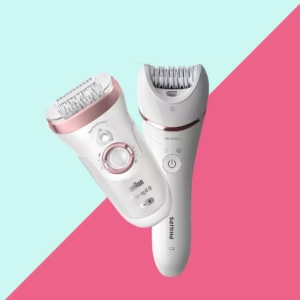
An epilator is an electric device with rotating tweezers that pull multiple hairs from the root simultaneously. Results last longer than shaving, roughly two to four weeks, because you are removing hair from the root.
The real situation: They are painful. Properly, genuinely painful, especially the first few times, and especially on sensitive areas. The upper lip, bikini line, and underarms are in a different category of uncomfortable. Some people tolerate it fine on the legs. Most people who have tried epilators have a story. I mean, if you do use an epilator, you must have a high pain threshold.
Best for: Legs, if you have a high pain threshold and want a cost-effective at-home option.
Skip if: You have low pain tolerance or are using it on sensitive areas.
Hair Removal Creams (Depilatory Creams)
Depilatory creams work chemically. They contain compounds (usually thioglycolate-based) that break down the keratin structure of the hair, weakening it at the skin’s surface so it can be wiped away. The hair is dissolved, not pulled, which means no stubble and no ingrowns from cutting. We have popular brands here in Nigeria like Veet, which has the classic and one for sensitive skin.
The real situation: They work, with a few caveats. The smell is unpleasant. You have to be careful with timing because leaving them on too long causes chemical burns. And the biggest limitation most people run into: most creams are not formulated for sensitive or intimate areas. The pubic region, inner thighs, and anywhere with thin or reactive skin require formulas specifically designed for those areas, and even then, a patch test is not optional. Regular creams on sensitive areas can cause burns, irritation, and discomfort that takes days to resolve.
Best for: Legs, arms, bikini line perimeter (not the full intimate area).
Skip if: You have sensitive skin, allergies to chemical formulations, or are planning to use it on intimate skin without a sensitive-area formula.
A note on the methods above: None of them is wrong. They are all tools, and tools have contexts. The reason conversation tends to move toward waxing, laser, and electrolysis is not that the above are bad — it is that, as we get older, the inconvenience of constant maintenance and the skin issues that come with temporary methods start to feel less worth it. We start asking: Is there something that actually lasts?
The Longterm Hair Removal Methods
These three: waxing, laser, and electrolysis, are what most people eventually land on when they want results that outlast Tuesday. They each work differently, cost differently, and suit different people differently. Here is what you actually need to know.
Waxing
How it works: Hot or warm wax is applied to the skin in the direction of hair growth, then removed quickly in the opposite direction, pulling the hair out from the root. There are two main types: soft wax (applied with a strip, removed with a cloth strip) and hard wax (applied thickly, hardens on its own, then peeled off directly). Hard wax is generally better for sensitive areas like the bikini line because it grips the hair rather than the skin.
Results: Smooth skin for two to four weeks, sometimes six for people whose hair grows slowly. Because the hair is removed from the root, regrowth comes in softer, finer hair over time. Many regular waxers notice a real reduction in hair density after months of consistent appointments.
Pain level: Real, but manageable for most people. The bikini and underarm areas are more sensitive. Going consistently actually helps, because the hair root weakens over repeated removal, and regrowth comes in thinner. First-time waxing is usually the worst.
Skin type and tone: Waxing works across all skin tones and hair textures. It is one of the most universally accessible professional options. However, people with very sensitive skin, eczema, rosacea, active breakouts, or those using retinoids or exfoliating acids need to be careful — waxing can lift skin in these cases.
Considerations before you go:
- Hair needs to be at least 0.5cm long for the wax to grip, so you have to grow it out between appointments. That in-between stage is the part nobody loves.
- Do not exfoliate or apply heavy products the day before waxing.
- Avoid sun exposure immediately after — freshly waxed skin is more photosensitive.
- Ingrowns are still possible, especially in the bikini area. Regular exfoliation between appointments helps significantly.
Cost in Lagos: A full-leg wax typically costs between ₦8,000 and ₦20,000. A Brazilian or bikini wax is usually ₦10,000 to ₦25,000, depending on the salon. Underarms tend to be cheaper, around ₦3,000 to ₦8,000. Pricing varies a lot by location and establishment.
The honest verdict: Waxing is a solid, well-established method. It is not permanent, which means it is a recurring cost. But for people who want reliable smoothness, can handle the maintenance window, and are not ready to commit to laser or electrolysis, it is genuinely one of the better options available. Many people stay with waxing long-term and are perfectly happy. The question is whether the ongoing cost and upkeep are worth it to you compared to something more permanent.
Laser Hair Removal
How it works: A concentrated beam of light is directed at the hair follicle. The pigment (melanin) in the hair absorbs the light, which converts to heat and damages the follicle, disrupting future hair growth. The keyword is “disrupts,” not “destroys,” which is why laser is technically classified as long-term hair reduction, not permanent removal.
Results: After a full course of sessions (typically six to eight treatments, spaced four to six weeks apart), most people see a 70 to 90 percent reduction in hair growth. Some hairs come back, often finer and lighter. Annual or biannual maintenance sessions are usually recommended to catch regrowth. The results, for most people, are genuinely transformative compared to any temporary method.
Pain level: Often described as a rubber band snapping against the skin, or a quick sting. Modern machines with cooling systems have made it much more tolerable. Sensitive areas are more uncomfortable than others, but most people find it very manageable compared to waxing or epilating.
The big skin tone conversation: This is important and often glossed over. Traditional laser hair removal works on the principle of the light targeting pigment in the hair. Early lasers were designed for light skin and dark hair — the contrast made targeting easy. For darker skin tones, the laser could not reliably distinguish between the hair and the skin, leading to burns, hyperpigmentation, and ineffective treatment.
The good news is that technology has improved substantially. The Nd: YAG laser is the current gold standard for darker skin tones — it uses a longer wavelength that passes more safely through the skin’s melanin to target the follicle. Many reputable clinics in Lagos and across Nigeria now use Nd: YAG machines. When booking, you should ask specifically what laser type the clinic uses, and whether the practitioner has experience and training working with darker skin tones. This is not a question to skip.
Who laser works best for:
- People with dark hair. Laser targets melanin, so it works best on pigmented hair. It is not effective on white, grey, blonde, or very light hair — there is simply not enough pigment to absorb the light.
- People who want significant, lasting reduction with minimal ongoing maintenance.
- People who can commit to the full course of sessions.
Preparation and aftercare:
- You need to shave the area 24 hours before your appointment. (Not wax, not epilate — shave, because the follicle needs to be intact.)
- Avoid sun exposure for at least two weeks before and after each session.
- No retinoids, AHAs, or exfoliants in the days leading up to treatment.
- SPF is non-negotiable on treated areas after each session.
- Expect some redness and mild swelling for a day or two post-treatment. This is normal.
Cost in Lagos: This varies significantly. A session for underarms might be ₦15,000 to ₦30,000. Full legs can run ₦80,000 to ₦200,000 per session. Brazilian/bikini is typically ₦25,000 to ₦70,000 per session. Reputable medical aesthetic clinics on the higher end of that range are usually worth it for the equipment quality and trained practitioners. This is not the time to choose purely by price.
The honest verdict: Laser is genuinely one of the better long-term investments in body care if you are a good candidate. The upfront cost is real, but spread across several months and compared to years of waxing, it can make financial sense. The most important thing is choosing a clinic that uses appropriate technology for your skin tone and has practitioners who know what they are doing. A bad laser experience is not just ineffective, it can cause lasting skin damage.
Electrolysis
How it works: A very fine needle or probe is inserted into each individual hair follicle. An electric current is delivered through the probe, destroying the follicle’s ability to produce hair. This is done one follicle at a time.
There are three types: galvanic electrolysis (uses direct current to create a chemical reaction that destroys the follicle), thermolysis (uses high-frequency alternating current to heat and destroy the follicle), and blend (combines both). Thermolysis is the fastest. Blend is considered the most effective. The type used depends on the practitioner’s equipment and approach.
Results: This is the only method currently recognised by the FDA as achieving true permanent hair removal. If the follicle is properly treated, that specific hair will not grow back. Ever. Unlike laser, which reduces hair growth, electrolysis eliminates it at the root, follicle by follicle.
The catch: One follicle at a time. This means electrolysis is time-intensive in a way that is hard to overstate. Treating a small area like the upper lip might take multiple sessions of 15 to 30 minutes each. A larger area like the legs or full bikini zone can require dozens of hours of treatment spread across months or even years. It is not a quick solution.
Pain level: It hurts. The sensation is often described as a sharp sting or a heat prick at each follicle. Numbing cream helps and most practitioners will use it for sensitive areas. The discomfort is manageable for most people, but sessions are longer, so the overall experience is more cumulative than something like laser.
Who electrolysis works for:
- Anyone, regardless of skin tone or hair colour. This is the single biggest advantage over laser. Because it uses electrical current and not light, it works on all hair types — white, grey, blonde, red, fine, coarse. And it works safely on all skin tones.
- People who want genuinely permanent results and are willing to invest the time.
- People who have completed laser and want to eliminate the remaining hair that was too light or fine for the laser to catch.
- People focusing on smaller areas like the face, hairline, bikini line, or underarms, where the time commitment is more realistic.
Cost in Lagos: Electrolysis is billed by time, usually per 15 or 30-minute sessions, ranging roughly from ₦100,000 to ₦350,000 per session depending on the clinic. But because of how many sessions a larger area requires, the total cost can become significant. For smaller areas, it is often quite reasonable.
Availability: This is worth noting honestly — electrolysis practitioners are less widely available in Lagos than laser clinics. It is a specialised skill, and finding a trained and experienced electrologist matters a great deal, as improper technique can cause scarring or hyperpigmentation. Do your research before booking.
The honest verdict: Electrolysis is the gold standard of permanent removal. If you have the patience for the process, it is remarkable. It is especially worth considering if laser is not working for you (due to hair colour or skin tone concerns), if you are targeting a specific small area and want to be truly done with it, or if you want to follow up on laser treatment for residual hairs. It is slow and not glamorous, but the permanence is real.
How They Compare: A Quick Reference
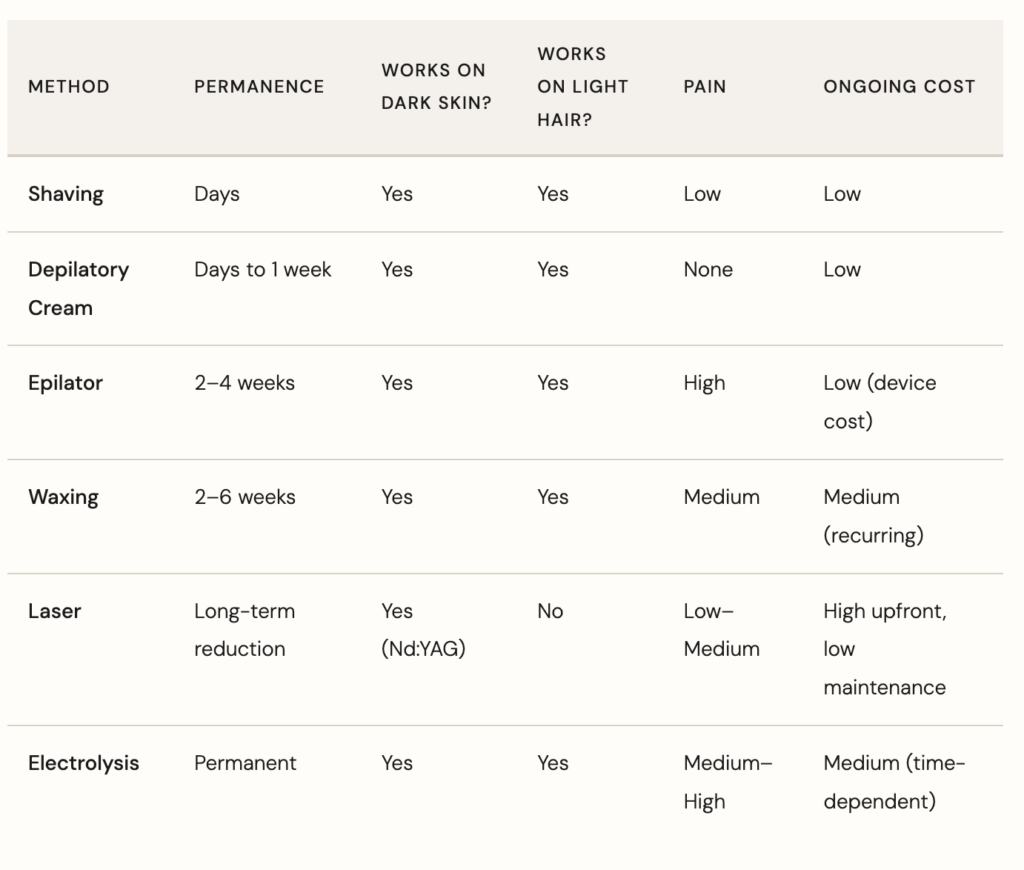
So, What Should You Actually Do?
The honest answer is that it depends on where you are in your hair removal journey, what you can afford, and what you are willing to tolerate. But here are some reasonable frameworks:
If you are waxing regularly and happy with the results, there is no urgent reason to change. Waxing is not a “step down” from laser — it is a different tool. The case for moving to laser is mostly about convenience and long-term cost, not about waxing being harmful. If you are consistent with your appointments and your skin handles it well, waxing works.
If waxing is starting to feel like a lot — the money, the grow-out window, the recurring appointments — laser is worth investigating seriously. It is a real investment but one with genuine long-term payoff for most people. The key is choosing a reputable clinic with appropriate equipment for your skin tone.
If you have stubborn areas that laser did not fully clear, or if your hair is too light for laser to target effectively, electrolysis is the next conversation. It is also worth considering for anyone who wants true permanence on a specific area and has the patience for the process.
If you are on a tight budget right now, there is no shame in maintaining a shaving or waxing routine while you save up for laser. The permanent options will still be there. Making a rushed decision with money you do not have and a clinic you have not vetted is worse than waiting.
One thing worth saying plainly: you do not have to remove any body hair at all. The entire premise of this article is navigating a choice we have already made — but that choice is yours. If you are doing this because it genuinely makes you feel good, that is a completely valid reason. If you are doing it purely from external pressure, it might be worth sitting with that for a moment. Either way, your body, your call.
