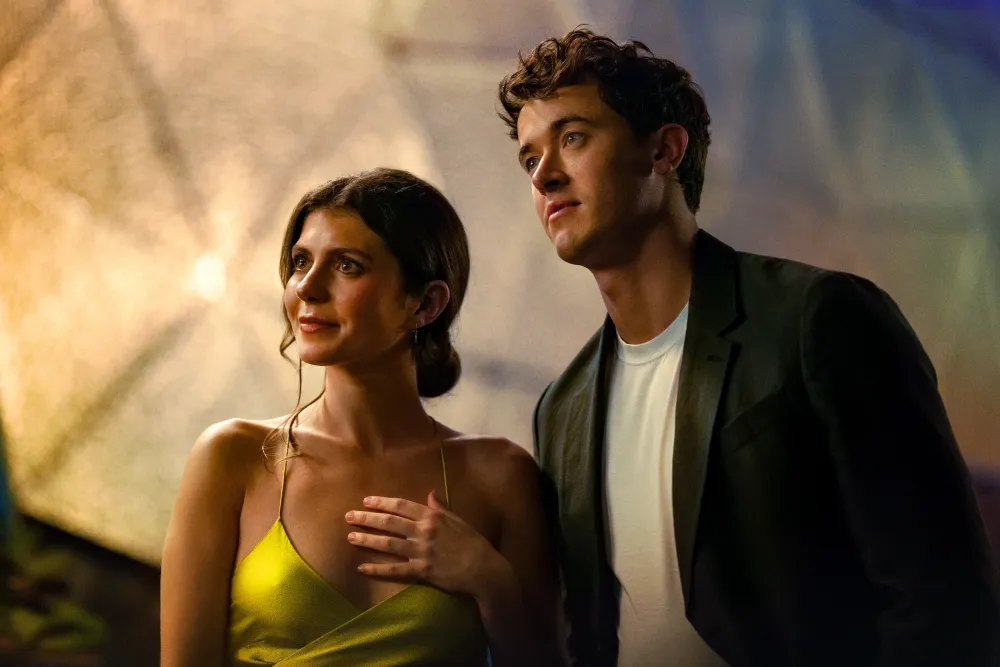
If you read the People We Meet on Vacation book before watching the movie, it feels a bit like listening to a sped-up version of a song you love. The melody is recognisable. The lyrics are mostly there. But something essential, the pause, the breath, the familiar feeling of ache, has been flattened.
And like me, if you went into the People We Meet on Vacation film expecting a scene-for-scene adaptation of Emily Henry’s novel, you will be disappointed. However, if you go in expecting a polished, emotionally legible rom-com loosely inspired by the book, you might actually enjoy yourself.
That distinction matters. Let’s talk about it.
The opening: the film tells you upfront that it is making a different story
In the book, we see Alex and Poppy at Sannibel, at their most alive when they are together, even when everything around them is humid, ugly, and chaotic. We see their rhythm and their shared language. We notice why this friendship isn’t just a “normal friendship.”
The film opens differently. Poppy is alone. There’s a joke about falling in the shower. It’s not a bad start; it’s funny, even, but it reframes the story immediately. Instead of “two people already tethered, we get “quirky woman searching for something.
That change alone sets the tone for everything else.
Let’s be fair. The movie gets a lot right. The performances are strong, especially in moments where the script steps back and lets silence do the work. Alex’s physicality, his awkward gentleness, the way he looks at Poppy when he thinks she isn’t watching, all of that translates well on screen. Poppy’s restlessness, her charm, her hunger for movement and experience, also land.
The film also understands that this story needs humour. It leans into comedy more than the book, and often successfully. Some of the updated jokes, the visual gags, and the heightened awkwardness play better on screen than they ever could on the page.

What happens when you compress a story into 2 hours?
In the book, everything starts because Poppy reaches out.
She texts Alex after distance and silence, knowing full well he might not meet her where she is. That message isn’t small. It’s a risk. It’s her choice to step back into something unresolved. From that one text comes the wedding, the trip, the reopening of their entire dynamic.
The movie dodges that risk.
Instead, David, Alex’s brother, invites Poppy to the wedding, and the plot gets moving without Poppy having to initiate anything. We get an awkward call with Alex, but it’s logistical, not emotional.
Losing the summers means losing the slow build
In the book, their relationship stretches across twelve summers. We don’t just see them meet; we see them repeat themselves, misstep, avoid conversations, and grow closer through accumulation. The film reduces this to nine summers, and we don’t move through them in the same way.
That compression also explains why we lose the text exchanges and, with them, the shared apartment owned by the truly awful Nikolai. In the book, that apartment matters. It’s hot, uncomfortable, and emotionally loaded. If you’ve ever dealt with housing drama, you know exactly why it works: forced proximity exposes everything. Affection, irritation, denial, all of it lives in the same space.
The movie skips this entirely, and with it, one of the most relatable and revealing phases of their relationship.
The same flattening applies to Poppy’s relationships outside Alex. It was great to see the New Orleans scene on screen, including Poppy’s boyfriend joining them, but the film doesn’t sit in the discomfort of that dynamic the way the book does. On the page, those moments are about comparison and denial. On screen, they pass more quickly.
The pregnancy scare, Sarah, and what the book actually reveals
The pregnancy scare remains one of the moments where the film comes closest to the emotional impact of the book. It still hurts. And when Alex later announces his engagement to Sarah, the heartbreak lands much the same way it does on the page.
But the surrounding context is thinner.
In the book, the pregnancy scare happens during the Tuscany trip. Poppy thinks she might be pregnant. She tells Alex. They are both frightened. She takes a test. It’s negative. Life moves on, at least on the surface. There is no big conversation where everything is resolved, and nothing about their relationship meaningfully changes in that moment.
What the film leaves out is what comes later.
In the book, Alex and Sarah have been dating on and off in the middle of his long friendship with Poppy. Sarah is not a sudden presence at the end of the story, and the overlap matters. It makes the situation ethically uncomfortable, and it also makes it genuinely strange that, after twelve years of friendship, Poppy has barely known Sarah at all. If you were Sarah, that would raise questions.
Much later, when Alex and Poppy finally confront everything they’ve been avoiding, Alex admits something the film removes entirely. He tells Poppy that the pregnancy scare in Tuscany frightened him so deeply that he later got a vasectomy.
The film keeps the scare and the engagement, but removes this context. Without the vasectomy, Alex’s choices appear cleaner and less complicated. The emotional messiness that defines the book is smoothed over, making the story easier to digest and disconnecting for the reader.

So… is it worth the watch?
The movie creates gaps, but it still feels familiar enough that key moments, the pregnancy scare, the engagement reveal, and the final run, hit emotionally. We love a great love confession + running scene, and it’s genuinely satisfying to see beloved characters brought to life by actors who clearly understand them.
Even though a lot of detail is missing, there’s still joy in seeing a favourite book translated to the screen.
I mean, I was screaming when Poppy walked in to “August” by Taylor Swift, and their dance scene in New Orleans had me kicking my legs in the air.
And whether that works for you depends entirely on what you loved about People We Meet on Vacation in the first place.