
Secure, anxious, avoidant, fearful-avoidant — attachment theory is everywhere right now, and for good reason. Once you understand it, you start to see it in everything.
You know that friend who sends three follow-up texts before you’ve replied to the first one? Or the one who disappears or starts to withdraw the second a relationship starts going well? Or the person who genuinely cannot understand why their partner needs so much emotional reassurance all the time?
That is attachment style at work. And there is a very real chance one of those descriptions just made you quietly defensive, which is also useful information.
Attachment theory was developed in the 1960s by British psychiatrist John Bowlby, who argued that the way we bond with our earliest caregivers becomes a kind of internal template for how we relate to people for the rest of our lives.
That is the thing about attachment. It is not really about your situationship, your ex, or that person who reads your messages and goes conspicuously quiet. It is about something much older than any of them. It is the answer to a question you have been asking your whole life, which is: why do I keep doing that? Or why do I always fall for the same kind of people?

What Are The Four Attachment Styles
A. Anxious attachment
The overthinker who noticed everything “Why haven’t you replied yet? Are you okay? I’m probably overthinking. Don’t mind me. Actually — are we okay?”
The anxiously attached person is always reading the room, and I mean always. They notice when you are slightly quieter than usual. They catch the shift in your tone. They are frequently the most empathetic people in any room, because they spent a childhood developing an almost forensic ability to read other people’s moods before anything was said.
The difficulty is that this same attunement makes relationships feel exhausting from the inside. Because they are also the person who, when you take two hours to reply, has already written and deleted four different follow-up messages and mentally rehearsed three different explanations for what your silence means. The intimacy they want so badly never quite feels stable enough to relax into.
Anxiously attached people are often described as clingy or “too much.” What they are is afraid, and doing the most rational thing a nervous system can do when love has historically felt unreliable, holding on tight, just in case.
They may prioritise words of affirmation as a love language, are prone to fall quickly for lovebombing, and struggle to stay in undefined relationships like situationships, entanglement or friends with benefits.
B. Avoidant attachment (Dismissive)
Self-sufficient, capable, and privately exhausted by intimacy“I’m fine. I don’t need much. No, really. I’m fine. Why do you keep asking?”
The avoidantly attached person has, usually without realising it, built a life that does not require too much from other people. They are often high-functioning, self-reliant, and good at handling practical crises. To the outside world, they look like they have it together, because they largely do, in all the visible ways.
But get emotionally close to them, and something shifts. Not unkindly, just distantly. There is a ceiling on intimacy that they cannot always see themselves. The more a relationship asks of them emotionally, the more they find themselves needing space. The more someone depends on them, the more restless they get. They often cannot tell you why.
Avoidant attachment is routinely misread as not caring. That is rarely what is happening. What happened, typically, is that early on, they probably learned that expressing emotional needs did not bring comfort.
They tend to prefer long-distance relationships because of the space and freedom they allow. They love self-sufficient partners, and while they often fall for anxious attachment people, the relationship often ends on a sour note, with them feeling like a bad person.
C. Fearful- avoidant attachment
The push-pull. The most complex, and the most misunderstood.“Come here. Actually, no. Wait — come back. I need space. Please don’t go.”
This is the most complex style, and also the most misunderstood. Fearful-avoidant people want deep connection with an almost desperate intensity, and then, when it starts to arrive, something in them runs. They pull people in and push them away in ways that confuse both themselves and everyone around them.
They are the hot and cold. The “I love spending time with you” followed by three days of distance for no clear reason. The relationship that goes beautifully until it goes a bit too well, and then something quietly detonates.
This pattern is sometimes called disorganised because, unlike the other styles, which have an internal logic, this one seems to work against itself.
Adults with fearful-avoidant attachment often describe wanting closeness so badly while also finding it terrifying when it actually shows up. They are not difficult for the drama. They are navigating contradictions that began long before they had language for any of it. It is a kind of burden most people will never understand unless they have carried it themselves.
They struggle with slow-burning love and thrive on intense chasing from their partner. While they might fall for lovebombing, the avoidant part of them also feels repulsed by it.
D. Secure attachment
The baseline we are all trying to reach“I like you, and I am not going to lose my mind about it.”
Securely attached people are comfortable being close to others and comfortable being on their own. They can tell you what they need without turning it into a whole thing when they do not get it immediately. They trust that relationships are generally safe. When there is conflict, they talk about it. When their partner needs space, they do not immediately assume the relationship is ending.
They feel things fully. They are just not living inside the worst-case scenario all the time.
If that sounds like a mythical person to you, sit with that reaction; it is telling you something.
So, How do You Know Your Attachment Style?
The beginning of a relationship tells you almost nothing, because new love is a great disguise. Everyone seems relatively stable when everything is fresh, and nothing has been asked of them yet. The honest data is in the middle, in the ordinary parts, after the initial high has worn off.
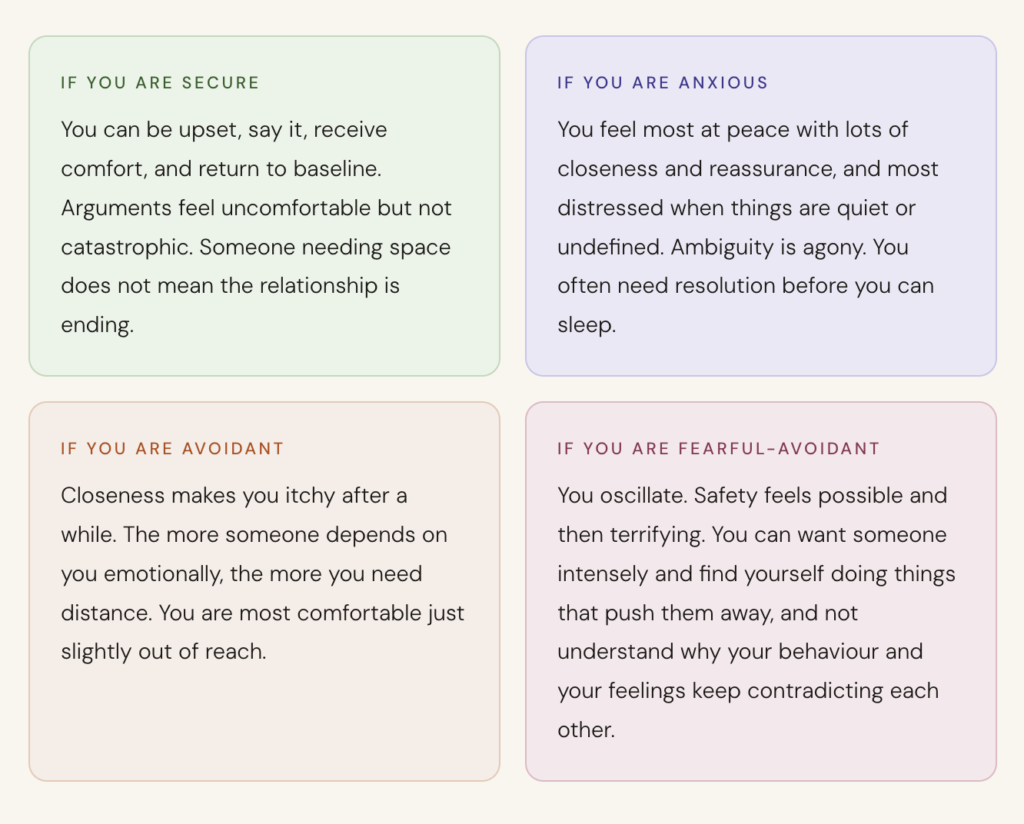
Pay attention to how you fight. Do you escalate and chase resolution? Do you shut down and leave the room? Do you go cold in ways that surprise even you? That is your attachment pattern, undisguised.
Pay attention to how you use reassurance. Does it settle you briefly and then wear off, so you need it again? Does it feel unnecessary, even slightly annoying? Do you want it, but find it almost impossible to ask for? All of that is data.
The most honest way to find yours is to pay attention to how you feel inside a relationship, not just what you do. Behaviour is the surface. The feeling underneath is the data.
And pay attention to the moment a relationship starts feeling serious, when the stakes rise, when someone starts needing things from you, when the newness wears off. Who do you become then? That person is doing the most honest thing you will see from your attachment style.
And now, the important part.
None of this is your fault; that is the actual point. Your attachment style was not chosen. It was learned quietly and efficiently in the years before you knew you were learning anything.
But knowing your style matters enormously, because awareness is not the same as destiny.
You can be anxiously attached and still build a relationship that does not consume you. You can be avoidant and learn to stay in the discomfort of closeness long enough to actually experience it. You can have fearful-avoidant patterns and work through them with a therapist, a safe partner, or simply with time, information, and a willingness to keep looking at yourself without flinching.
Understanding your attachment style helps you manage your “tendencies” so you can have a healthy, secure relationship.